
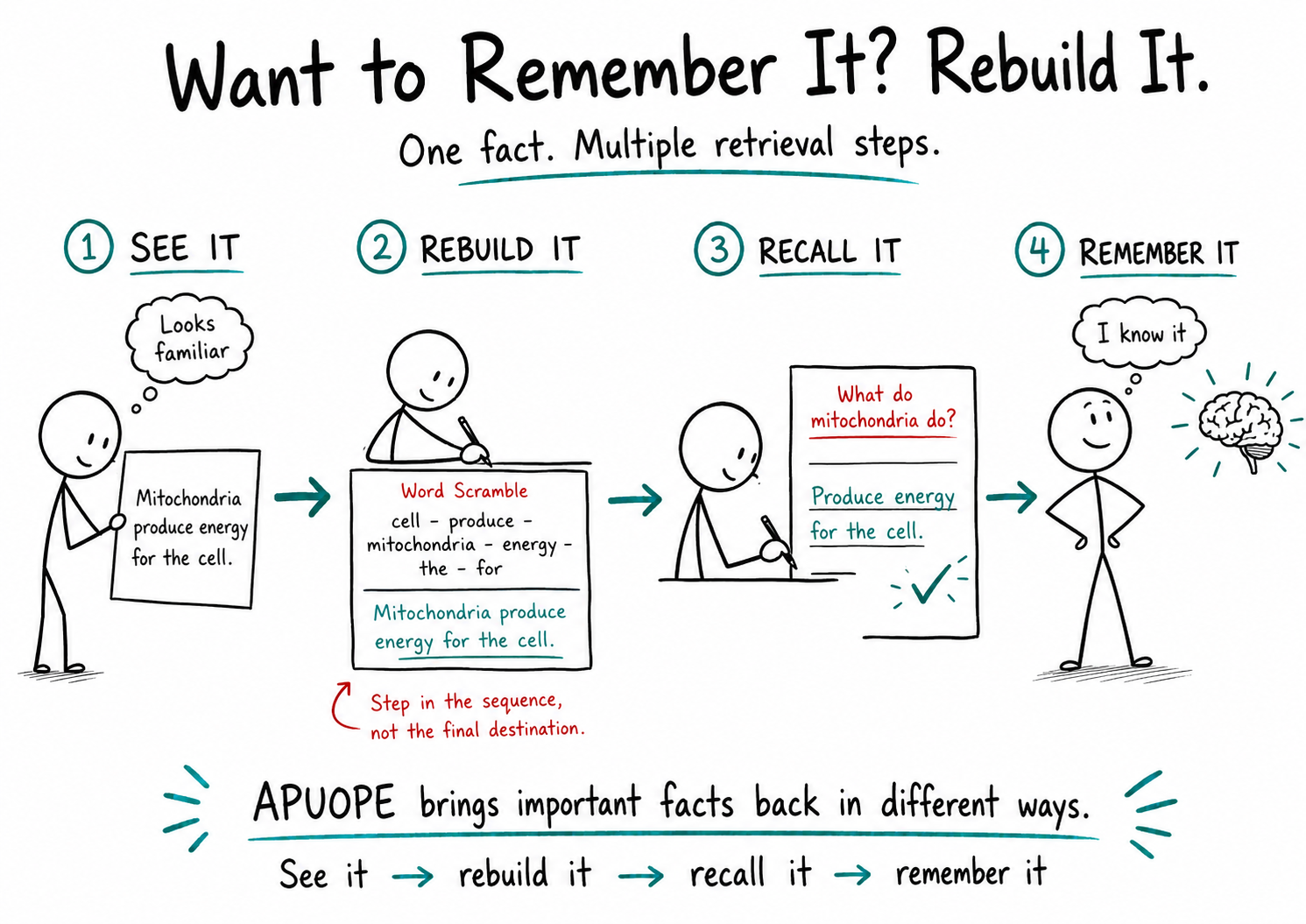
How reconstructing important facts can make them easier to remember.
You read an important fact.
It makes sense.
A few minutes later, you see it again.
Still familiar.
Then someone asks you about it without showing you the answer.
And suddenly you cannot remember it.
This is one of the problems with passive studying.
Seeing information repeatedly can make it feel familiar without making it easy to retrieve.
APUOPE approaches this differently.
Instead of showing you an important fact once, testing it once and moving on, APUOPE can bring that same knowledge back through a sequence of retrieval exercises.
Word Scramble is one part of that sequence.
And its job is simple:
Give you the pieces — but make your brain rebuild the fact.
One Quiz Is Not the Point
Imagine you are studying biology and APUOPE identifies this as an important fact:
Mitochondria produce energy for the cell.
Testing that fact once tells us something.
Maybe you know it.
Maybe you guess correctly.
Maybe you recognize the answer when you see it.
But one successful answer does not necessarily mean the knowledge is secure.
That is why APUOPE does not have to treat learning as:
Study → Quiz → Done
Instead, the same important knowledge can return again.
And again.
In different forms.
Each encounter asks your brain to retrieve or reconstruct the knowledge rather than simply reread it.
That is sequenced retrieval.
The goal is not to pass one quiz.
The goal is to make the knowledge increasingly easier to bring back.
Word Scramble Is One Step in That Sequence
At one point in the sequence, APUOPE may give you:
cell — produce — mitochondria — energy — the — for
You already have some help.
The important words are visible.
But the completed fact is not.
You have to reconstruct:
Mitochondria produce energy for the cell.
That makes Word Scramble an interesting middle ground.
It is harder than simply reading the answer.
But easier than being asked:
What is the function of mitochondria?
with no help at all.
You are retrieving the knowledge with support.
And that support can be useful while the memory is still developing.
Retrieval Can Become Progressively Harder
Think about learning as gradually removing the training wheels.
At first, you may see most of the information.
Then APUOPE asks you to do more of the work.
For example, the learning journey around one fact might move through different levels of support:
Exposure
You first encounter and understand the fact.
Mitochondria produce energy for the cell.
Recognition
You identify the correct idea among alternatives.
Reconstruction
Word Scramble gives you the pieces:
energy — cell — mitochondria — for — produce — the
You rebuild the fact.
Retrieval
Later, you may need to produce the idea with much less help.
What is one important function of mitochondria?
Repetition
The knowledge returns later instead of disappearing after one successful answer.
The exact exercise can change.
The knowledge being strengthened stays the same.
That distinction matters.
Why Not Just Ask the Hardest Question Immediately?
Because learning is not always improved by making every question as difficult as possible.
Imagine you have only just learned about mitochondria.
If the first thing APUOPE asks is:
Explain the role of mitochondria in cellular respiration.
you may have no idea where to begin.
That does not necessarily mean the exercise is helping you learn.
It may simply be too large a jump.
Word Scramble reduces that jump.
The important pieces are still available.
But you have to put them together.
You are not merely recognizing the finished answer.
You are beginning to retrieve it.
Then, as the knowledge becomes stronger, APUOPE can ask for more.
Rebuilding Forces You to Pay Attention
Consider:
The heart pumps blood through the body.
If you simply read the sentence, it is easy to move past it.
But suppose you receive:
body — blood — heart — through — pumps — the — the
Now you have to determine how the ideas connect.
What performs the action?
What is being moved?
Where is it going?
You reconstruct:
The heart pumps blood through the body.
The activity may take only seconds.
But during those seconds, you interacted with the structure of the fact instead of simply looking at it.
Familiarity Can Fool You
Now consider this definition:
Acceleration is the rate of change of velocity.
You might read it three times and think:
“I know that.”
But then APUOPE gives you:
velocity — change — acceleration — rate — of — is — the — of
Can you reconstruct the definition?
If you hesitate, you have discovered something useful.
The information looked familiar.
But it was not yet easy to retrieve.
That is exactly the kind of weakness a learning system should find.
Because once it finds it, the knowledge can come back again in the sequence.
Getting It Wrong Is Not the End of the Exercise
This is another important difference between a quiz and a learning system.
A traditional quiz often asks:
Did you know it?
Yes or no.
Then it moves on.
But during learning, getting something wrong should change what happens next.
If you struggle to reconstruct an important fact, that fact should not simply disappear because the question is over.
It needs more retrieval.
More exposure.
Perhaps more support.
Then another attempt.
The purpose is not merely to measure memory.
The retrieval itself is part of building the memory.
The Same Knowledge, Different Mental Work
This is where sequenced retrieval becomes powerful.
Suppose the important fact is:
Insulin lowers blood glucose levels.
You might encounter that knowledge several times.
But you should not necessarily encounter it in exactly the same way every time.
One exercise might help you recognize it.
Another might make you rebuild it.
Another might ask you to recall it.
Another might require you to use it in a larger question.
The underlying fact remains:
Insulin lowers blood glucose levels.
But the amount of help changes.
Your brain gradually takes over more of the work.
That is very different from answering the exact same multiple-choice question five times.
Word Scramble Is Scaffolding
That is probably the best way to think about APUOPE's Word Scramble.
It is scaffolding for retrieval.
The answer is not handed to you.
But you are not left completely alone either.
The pieces are there.
Your brain has to rebuild the structure.
And once you can do that reliably, you can move toward retrieval with less support.
See it.
Recognize it.
Rebuild it.
Retrieve it.
Retrieve it again later.
Knowledge becomes stronger not because you saw it once, but because your brain repeatedly had to bring it back.
The Goal Is Not to Become Good at Word Scrambles
You are not studying biology to become excellent at rearranging biology sentences.
Word Scramble is just one tool.
The actual target is the knowledge behind the exercise.
Eventually, if someone asks:
What do mitochondria do?
you should not need six scrambled words.
You should know.
That is why APUOPE can move between different types of exercises rather than treating one quiz format as the learning process.
Each exercise can serve a different purpose.
Word Scramble helps bridge the gap between:
“I recognize this when I see it.”
and
“I can bring this back myself.”
Learning Is Not One Successful Answer
This may be the bigger lesson.
Knowing something once is not the same as being able to remember it tomorrow.
Recognizing something is not the same as retrieving it.
And passing one quiz is not the same as mastering the knowledge.
Important information needs to come back.
But each time it comes back, your brain should have to do some of the work.
Sometimes that means recognizing.
Sometimes reconstructing.
Sometimes recalling.
Sometimes applying.
That is why Word Scramble is not just a small game inside APUOPE.
It is one part of a larger idea:
Don't just show learners information repeatedly. Make them retrieve it repeatedly.
And when full retrieval is still too difficult?
Give them the pieces.
Then make them rebuild it.
Want to remember it? Rebuild it.